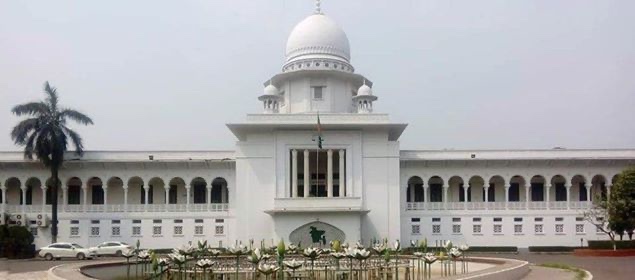
HCD rejects the writ petition that challenged the legality of shooting at protesters
A writ petition challenging the detention of six coordinators of the Anti-Discrimination Student Movement in DB custody was filed in August 2024. The petition also raised the question of whether the use of live ammunition against protesters was valid. The HCD bench, consisting of Justice Mustafa Zaman Islam and Justice SM Masud Hossain Dolon, rejected the writ, observing, however, that it is a constitutional mandate that every citizen of the country shall have the right to assemble and participate in peaceful procession and public meetings.
As the court observed, human dignity must be recognised as the most precious resource, and the law-enforcement agencies should treat it as paramount. The Court also held that the use of force is only sanctioned when necessary for a particular situation, such as when an assembly becomes unlawful. The Court recommended that law-enforcement agencies uphold these fundamental human rights and refrain from discrimination against any individual or group.
Moreover, according to the Court, police or a member of any law enforcement agency may use rubber bullets and tear shells if anyone violates the law. However, resorting to live rounds should only occur when rubber bullets and tear shells cannot prevent the violation, or the assembly has escalated into a riot. Additionally, it was noted that any member of law enforcement who fails to comply with these obligations, substantive or procedural, will be held accountable.
Interim Government forms upon the Appellate Division’s approval
President Mohammed Shahabuddin consulted the Appellate Division (AD) of the Supreme Court before establishing the interim government through the law ministry, in accordance with Article 106 of the Constitution. A full bench, headed by the Chief Justice Obaidul Hassan, and other judges, namely Justice M Enayetur Rahim, Justice Md Ashfaqul Islam, Justice Md Abu Zafor Siddique, Justice Jahangir Hossain Selim, Justice Md Shahinur Islam and Justice Kashefa Hussain, delivered this opinion.
The Court stated that the President has the authority to establish an interim government in light of the current situation, given the absence of a Parliament and the former Prime Minister’s resignation. Under Article 106, the President may refer a question of law to the Appellate Division for consideration if it can be regarded as a matter of public importance. This reference is needed to form an interim government, given the absence of any specific constitutional provision to that effect.
Supreme Judicial Council is revived with the power to remove judges for incapacity or misconduct
The Appellate Division has issued an order reviving the Supreme Judicial Council after holding a hearing on a review petition challenging the earlier SC verdict that struck down the 16th Amendment to the Constitution. The HCD judgment of the 16th Amendment case, concerning the legality of the Supreme Judicial Council, will remain in force. Moreover, empowered by Article 96 of the Constitution, the Court also drafted a 39-point Code of Conduct for the Supreme Court Judges. A six-member bench of the Appellate Division, headed by Chief Justice Syed Refaat Ahmed, declared this order.
On 24 December 2017, the Hasina-led government filed a review petition with the Appellate Division, following the HCD’s earlier declaration of the 16th Amendment unconstitutional. The review petition contained 94 arguments on which the Court might consider the prayer to restore the 16th Amendment. The review petition sought to set aside the decision establishing the Supreme Judicial Council.
It is worth noting that the 16th Amendment Act abolished the SJC system led by the Chief Justice and restored Parliament’s power to remove SC judges. Previously, the government appealed the HCD verdict in 2016; in 2017, the AD rejected the appeal and upheld the HCD decision.
Indemnity of the Energy Minister from legal disputes is held unconstitutional
Two Supreme Court lawyers, Dr Shahdeen Malik and Md Tayeb-Ul-Islam Showrov, filed a writ petition challenging the legality of sections 9 and 6(2) of the Quick Enhancement of Electricity and Energy Supply (Special Provisions) Act, 2010. These two sections safeguard rental and quick-rental power plants from legal disputes and grant the Energy Minister exclusive authority to approve electricity purchase plants. In September 2024, the HCD bench asked the relevant authority why the sections should not be declared unconstitutional.
Section 9 asserts that any action done under the said Act cannot be questioned in the Court of law. Whereas following this provision, as per section 6(2), if any planning or proposal on the buying or investment decisions is taken by the Energy Minister, it should be sent to the cabinet committee for approval, but cannot be challenged in a Court. In this way, the Act gives the minister an indemnity.
The HCD bench of Justice Farah Mahbub and Justice Debasish Roy Chowdhury precisely ordered that all the power plants should be activated without delay for the benefit of the citizens and the nation’s economy. Additionally, it was declared that the impugned sections of the quick rental law that precluded legal disputes against the Energy Minister are unconstitutional. The law in question has been repealed by the Quick Enhancement of Electricity and Energy Supply (Special Provisions) (Repeal) Ordinance 2024.
HCD bench refrains from passing a ban order on ISKCON
In November 2024, a lawyer was killed in the Chattogram Court Building area, during hostilities that erupted between police and the followers of the former ISKCON leader Chinmoy Krishna Das Brahmachari. The clash occurred shortly after Chinmoy’s bail was rejected and he was remanded to jail as an accused in a sedition case. The lawyer, 32-year-old Saiful Islam, was fatally assaulted and pronounced dead upon being admitted to Chattogram Medical College Hospital.
On 27 November, the Supreme Court lawyer Md Monir Uddin submitted two newspaper reports to the HCD bench regarding ISKCON, seeking the issuance of a suo motu order on the government calling for a ban on ISKCON’s undertakings and enforcement of section 144 in Chattogram, Rangpur, and Dinajpur. On the same day, the Court asked the Attorney General to report on the government’s actions regarding the organisation’s recent activities, including the rally, the clashes and violence that occurred in Chattogram.
Further, the Court was made aware that three cases had been filed regarding the violence that ISKCON’s supporters in Chattagram had instigated, and that 33 accused had been arrested. Besides, six people who were involved in killing the lawyer had been identified by scrutinising CCTV footage.
The HCD bench of Justice Debasish Roy Chowdhury and Justice Farah Mahbub refrained from passing any order to ban ISKCON’s activities in Bangladesh. The Court did not intervene, noting that the government was actively addressing the matter, as reported by the Attorney General’s office. The Court expected the government to cautiously maintain law and order to protect people’s lives and property, as it is constitutionally responsible for ensuring the security of the state.
‘Joy Bangla’ is no longer the national slogan
In 2020, the HCD proclaimed that ‘Joy Bangla’ is the country’s national slogan and ordered the government to undertake the necessary measures to use the slogan at every state function and in academic institutions’ assemblies. In November 2024, the current interim government filed a leave-to-appeal petition seeking a stay of the HCD verdict. A four-member bench of the Appellate Division, led by the Chief Justice Syed Refaat Ahmed, issued an order. The order’s consequence was that the AD stayed the HCD verdict, which affirmed ‘Joy Bangla’ as the country’s national slogan. The AD further opined that the national slogan is a matter of government policy and that the judiciary cannot interfere.
HCD declared that scrapping the non-party caretaker government system is unconstitutional.
The HCD bench of Justice Farah Mahbub and Justice Debasish Roy Chowdhury issued a ruling on two distinct writ petitions challenging the legality of the 2011 15th Amendment to the Constitution. It was argued that the amendment that abolished the non-party caretaker government system led to three consecutive controversial elections in 2014, 2018, and 2024.
The HCD, earlier, in August 2024, issued a rule nisi on why the 15th Amendment should not be declared unconstitutional. This system was introduced by the 13th Amendment in 1996. Additionally, in the same month (August 2024), a petition was filed with the Appellate Division seeking review of its 2010 verdict.
The HCD scrapped the specific parts of the amendment that dealt with the cancellation of the provision of the non-party caretaker government system. The Court held that the abolition of the non-party caretaker government system is void and unconstitutional because it interfered with the basic structure of the Constitution, including free and fair elections, democracy, and the independence of the judiciary.
The Court also declared that the current interim government is not a caretaker government in this sense, as it was formed under Article 106 of the Constitution. The HCD also struck down Articles 7A and 7B of the Constitution, holding them void and unconstitutional.

















No Comments
Leave a comment Cancel