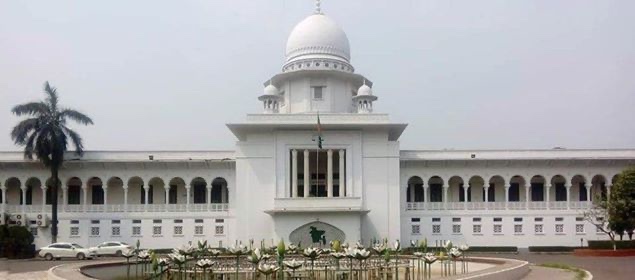
This edition of ‘From the Court Corridor’ curates the notable pronouncements of the High Court Division (HCD) and the Appellate Division (AD) of the Supreme Court (SC) of Bangladesh from January 2025 to June 2025.
Writ petition challenging the formation of the interim government summarily rejected
The HCD on 13 January 2025 summarily rejected a writ petition challenging the process of formation and oath-taking of the present interim government. The AD bench, led by Chief Justice Syed Refaat Ahmed, also confirmed the HCD’s decision on 4 December 2025.
Earlier, following the ouster of the previous regime through a mass uprising on 5 August 2024, the then prime minister flew to India, and President Mohammed Shahabuddin sought AD’s advisory opinion under Article 106 of the constitution to fill the political lacuna. The AD, in turn, opined that an interim government may be formed to carry out the executive functions of the state, and the president may appoint a chief adviser, other advisers to the interim government and may administer an oath to them. Accordingly, the President formed the interim government, which was sworn in on 8 August 2024.
However, the petitioner, Mohammad Mohsen Rashid, challenged the formation of the interim government on the grounds that the president’s reference to the SC was invalid because no prior notice was issued, and the AD judges’ opinion was given under duress. The petitioner himself appeared on his behalf, whereas Additional Attorney General Aneek R Haque represented the State.
The bench of Justice Fatema Najib and Justice Sikder Mahmudur Razi, while rejecting the petition, termed it ‘malicious’ and ‘unacceptable’ since the interim government was formed and sworn in under the opinion of the AD.
Basically, Rule 1 of Order XXVIII of the Supreme Court of Bangladesh (Appellate Division) Rules 1988 requires the Registrar to give notice to the Attorney-General of Bangladesh to appear before the Court on a day specified in the notice to take the directions of the Court as to the parties who shall be served with notice of the Special Reference. However, the verdict of the HCD and the AD’s confirmation, according to Attorney General Md Asaduzzaman, have settled the legality of the interim government and left no room for further controversy.
Divisional commissioners summoned as illegal kilns remain operational
On 29 January 2025, the HCD bench of Justice Farah Mahbub and Justice Debashish Roy Chowdhury summoned the Divisional Commissioners of Dhaka, Chattogram and Khulna; the Deputy Commissioners (DCs) of Nilphamari, Kurigram, Lalmonirhat and the Upzilla Nirbahi Officers (UNOs) of Savar and Dhamrai, directing them to appear before the court on 12 February to explain their failure to comply with its orders to shut down illegal brick kilns. Advocate Manzil Morshed appeared on behalf of the petitioner, while Deputy Attorney General Tanim Khan appeared on behalf of the state.
The matter originates from the directives issued by the HCD to close illegal brick kilns across the country in a PIL filed by Human Rights and Peace for Bangladesh (HRPB) in 2022. Upon hearing the parties, the HCD on 13 November 2022 ordered the defendants to stop all the activities of illegal brick kilns. As the directives yielded little result, the HCD again, on 28 November 2024 redirected the divisional commissioners of each division to take effective steps to stop the illegal brick kilns.
The report-in-compliance submitted by the Divisional Commissioners revealed that names of previously closed brick kilns were again listed as ‘closed’, while all illegal brick kilns de facto continued to operate. Against such a backdrop, HRPB filed a supplementary application to the HCD seeking an explanation from the concerned, and the HCD accordingly summoned them.
Judicial activism has long been the driving force behind environmental governance in Bangladesh. However, the present case exposes the administrative inertia. The HCD’s move to summon the DCs undoubtedly marks a timely attempt to bridge the gap between judicial activism and its execution.
On 21 January 2025, the Supreme Court Judges’ Appointment Ordinance 2025 (hereinafter, the Ordinance) came into effect, delineating the procedure for appointing judges of the apex court. Section 3 of the Ordinance established a permanent council for the purpose of assisting the Chief Justice in the process of advising the President regarding the appointment of Judges to the Supreme Court. Sections 4, 6 and 9 of the Ordinance engraft the Secretary of the Council, the power and functions of the council, and recommendations regarding the appointment of Judges to the Appellate Division, respectively.
The petitioner, Supreme Court lawyer Md Ajmol Hossain Khokon, filed the writ petition on February 26, challenging the legality of sections 3, 4, 6 and 9 of the Ordinance. Supporting the petition were senior advocates Zainul Abedin, Barrister Md Bodruddoza Badal, Barrister Kayser Kamal, and Mohammad Shishir Manir; representing the State was Additional Attorney General Aneek R Haque. The bench of Justice A K M Asaduzzaman and Justice Syed Enayet Hossain did not hear the petition at once and sent it to the Chief Justice of Bangladesh (CJB) for assigning a bench to hear the petition.
On CJB’s referral, the HCD bench comprising Md Akram Hossain Chowdhury and Justice Debasish Roy Chowdhury heard the petition and handed down the verdict. On 28 April 2025, Justice Md Akram Hossain Chowdhury opined, ‘A complete law is needed as the ordinance is not enough. We have heard and noted the arguments. The writ petition is disposed of with observations.’
Article 95(2)(c) of the constitution provides that further qualifications for appointment of persons as judges of the Supreme Court may be prescribed by law. This ordinance, being the pioneer of its species in Bangladesh, fills the legislative vacuum regarding the appointment of judges to the highest judiciary, wherein no detailed guidelines had earlier prevailed.
Abrar Fahad murder case: HCD upholds death sentence for 20 and life imprisonment for 5
In a death reference under Section 374 of the Code of Criminal Procedure 1898 (hereinafter, CrPC 1898), the HCD bench of Justice A K M Asaduzzaman and Justice Syed Enayet Hossain on 16 March 2025 confirmed death sentences of 20 convicts in the Abrar Fahad Murder Case.
Abrar Fahad was a second-year EEE Student at Bangladesh University of Engineering & Technology (BUET) who was beaten to death by the then Bangladesh Students’ League (BSL) activists on 6 October 2019. The murder stemmed from a Facebook post where Abrar critiqued the diplomatic relations between Bangladesh and India. This gruesome incident reignited debates on campus violence and the unchecked influence of student politics in Bangladesh.
The investigation was taken up by the Detective Branch (DB) and was completed within only 37 days. The account of the incident pierced the collective conscience of society. Abrar was beaten mercilessly; the blows continued even after the stamps broke and his cries for water brought no ounce of relief.
On 8 December 2021, the Speedy Trial Tribunal-1 of Dhaka handed down its judgment in the case, and the death sentences were sent to the HCD for confirmation. Justice AKM Asaduzzaman’s bench began hearings on 28 November 2024 of both the appeals filed by the convicts and the death references. The State was represented by Attorney General Md Asaduzzaman and a team of deputies, while the defence was conducted by advocates S M Shahjahan, Azizur Rahman Dulu, Masud Hasan Chowdhury, and Mohammad Shishir Manir. The bench unanimously accepted the death references and dismissed the appeals.
The constitution in Article 32 enshrines the right to life in prohibitive terms and allows deprivation solely in accordance with law. Article 35(5) imposes an absolute prohibition on torture and on cruel, inhuman, or degrading treatment, admitting of no restriction whatsoever. In carrying these constitutional guarantees into effect, the verdict sends a clear message that political violence on campuses will not go unpunished and ensures justice for society at large.
Major Sinha murder case: HCD confirms death sentences for two, life imprisonment for six
On 2 June 2025, the HCD bench comprising Justice Mohammad Mostafizur Rahman and Justice Md Sagir Hossain confirmed the death sentence of two former police officers, former officer-in-charge (OC) of Teknaf police station Pradeep Kumar Das and former Sub-Inspector (SI) Liaqat Ali, in the murder case of retired army Major Sinha Md Rashed Khan. The hearing began on 23 April 2025 after Chief Justice Syed Refaat Ahmed directed the matter to be disposed of on ‘a priority basis’.
Earlier on 31 July 2020, Sinha was shot dead at a checkpoint on the Cox’s Bazar-Teknaf Marine Drive in Shamlapur by Inspector Liaqat Ali, who was then serving at the Baharchhara Investigation Centre. The motive of the murder, as appearing from the chargesheet submitted by RAB, was that the then OC Pradip used to stage gunfights and extort people for money under the pretext of a war on drugs. Fearing exposure of his illicit activities by Sinha, Pradip orchestrated Sinha’s killing through Liaqat’s gunfire and later portrayed it as an armed encounter.
The Cox’s Bazar District and Sessions Judge’s Court convicted the accused on 31 January 2022. OC Pradeep and SI Liaqat were sentenced to death, whereas ex-SI Nandadulal Rakkhit and former constables Rubel Sharma and Sagar Deb, amongst others, were sentenced to life imprisonment. As a matter of course, the death sentences were sent to HCD under Section 374 of CrPC 1898 for confirmation, and the convicts also appealed to the HCD. The HCD bench unanimously dismissed the appeals and upheld the sentences.
It is a renowned maxim foundational to the rule of law that ‘Be you ever so high, the law is above you.’ The conviction stands as a promising testament to this principle and shines bright in upholding accountability within law enforcement agencies.
HCD issues rule on formation of a special security force for the court premises
The HCD on 30 June 2025 issued a Rule Nisi asking the government to show cause why it should not be directed to form a ‘special security force’ under judicial authority to ensure security at court premises. Arifur Rahman Murad Bhuiyan, a resident of Narsingdi, filed the writ petition on 12 February 2025. He represented himself in the hearing, whereas Deputy Attorney Generals Shafiqul Rahman and Tanim Khan appeared on behalf of the state.
After a preliminary hearing, the division bench comprising Justice Fahmida Quader and Justice Syed Zahid Mansur issued the rule.
Given the precarious security of lawyers, judges and witnesses in the court premises, the rule issued by the HCD is nothing short of a milestone. In the USA, United States Marshals Service, Judicial Security Division, performs the function of ensuring the safety of court premises. The Supreme Court of India also suggested the creation of ‘permanent security units’ to guard court premises. The creation of such a special force would inevitably effectuate the constitutional promise of securing the rule of law as enshrined in the preamble.



















No Comments
Leave a comment Cancel