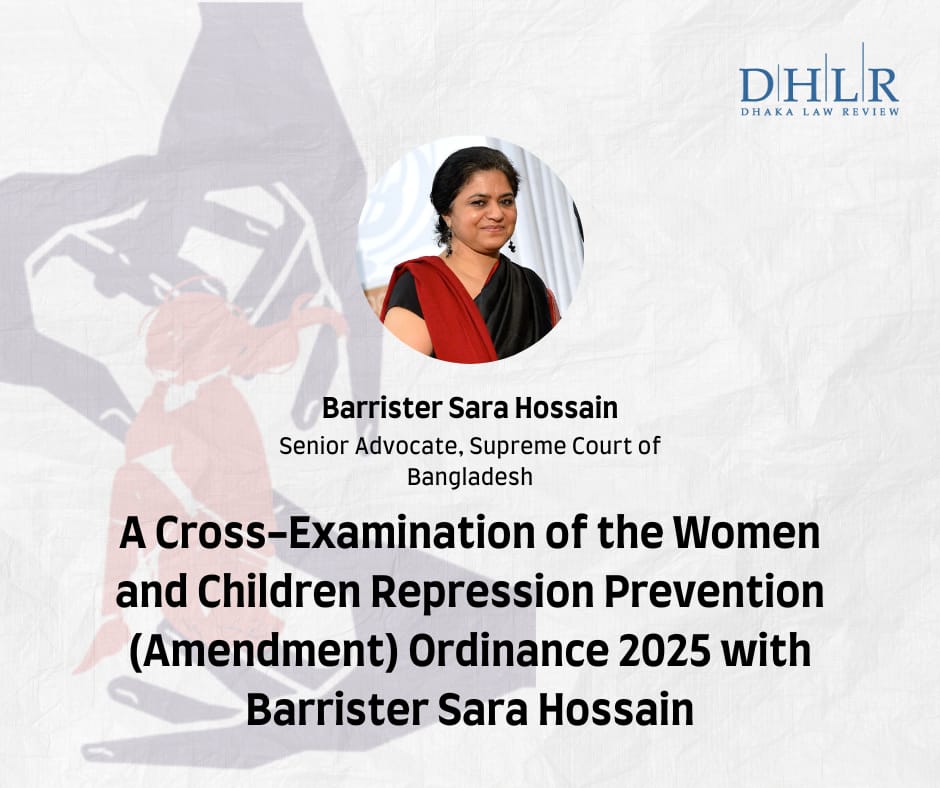
DHLR: In your opinion, how significant is the recognition of the rape of adolescent boys in the Women and Children Repression Prevention (Amendment) Ordinance 2025, through the definition of ‘বলাৎকার’ in aligning Bangladeshi law with contemporary understanding of sexual violence? Where, in your view, do the definition and its underlying framework still leave conceptual gaps? And is the definition drafted broadly enough to capture offences against adult male victims?
Sara Hossain: Let us start with reviewing what amendments have been made, after over 150 years, to the original definition of rape in the Penal Code of 1860. First, the inclusion of the word ‘penetration’ in the earlier definition meant that our understanding of rape was confined to one particular form of sexual violence, that is, penile-vaginal penetration by force or without consent. This amendment has gone quite far to cover other forms of sexual violence, even when there is no penetration. However, there are still some gaps in the amended definition provided in the 2025 Ordinance. To begin with, it does not fully criminalise marital rape. Moreover, the issue of age remains unresolved. Another issue that has not been fully covered, though it is arguably somewhat covered by our case law, is the extent to which visible signs of injury need to be shown to prove rape.
On the issue of adolescent boys, it is a positive change that the rape of adolescent boys is now recognised in the law as a separate offence. The definition now envisages the perpetrator being either a man or a woman. But there is no adequate protection for adult males against non-consensual or forcible sexual violence.
Moreover, making this law gender neutral may result in women facing a new form of harassment. In our context, where false and baseless claims are rife, and the law is often misused as an instrument of harassment or oppression, gender neutrality may play out to further victimise women. Before this amendment, at least one could be sure that women would not face false charges, but that is no longer the case. This is something we should watch out for. All in all, the 2025 amendment is largely positive and progressive, but we have to be cautious in tracking its implementation; even progressive amendments can have problematic impacts depending on who uses them and how, and whether there are sufficient safeguards in place in practice to ensure fair trial of the accused as well as the right of the victim to justice.
DHLR:Under the Women and Children Repression Prevention Act 2000 (WCRPA), we have offences for both rape and sexual violence, but no offence for sexual harassment falling short of these two. Section 10 does, to some extent, deal with the physical element of sexual harassment, but not other forms like verbal harassment. Do you think that sexual harassment is sufficiently addressed in our legal framework, or was this a missed opportunity to substantiate it in this law?
Sara Hossain: Yes, I think it was a bit of a missed opportunity, perhaps because another draft ordinance was in the mix this year, related to sexual harassment. Unfortunately, it was not ultimately promulgated as an Ordinance during the Interim Government. It is important that the new Government take up the baton and ensures that we have legal protection against sexual harassment covering educational institutions, workplaces and public places. This would give a clear signal of its commitment to put in place legal protections against violence against women, and encourage women’s access to education and employment.
DHLR: The Ordinance mandates significantly reduced investigation and trial disposal timelines. From an institutional and practical standpoint, do you believe these accelerated timelines will enhance justice delivery, or do they risk compromising the quality of investigations and adjudication?
Sara Hossain: In practice, case disposal and investigation periods are often unduly prolonged, and as a consequence, the complainants in cases of sexual violence lose hope and discontinue the process. There are also allegations that investigations may be unduly prolonged due to pressure or influence from the accused party, particularly when the accused has powerful political or social connections. So, the new time limits have been imposed in response to legitimate concerns. But, at the same time, there are real worries that these time limits are not necessarily realistic. Moreover, we have also seen time limits imposed by law in the past, but given the ground realities, the Courts held that these time limits are only directory, not mandatory.
The present time limits of 30 days for investigation and 90 days for disposal may prove quite difficult to maintain. However, some may also argue that they are realistic since there are now opportunities for expedited investigations, given the availability of electronic and biological evidence. But there is a risk that many new cases may arise due to more broadly defined offences, and that biological evidence may be unreliable and electronic evidence may be manipulated by emerging technologies. Therefore, whether these deadlines will work, unless we have, in addition to the law, clear monitoring and tracking of cases, changed work practices on the part of the police, and some kind of accountability mechanism, is up for debate.
DHLR: To expand on the previous question, what would be a positive step in terms of timeline? One major complaint about laws and the court system is that resolving a case can be a lengthy process. We have a separate Tribunal just for this Act, but what else do you think could be incorporated to help reduce this load?
Sara Hossain: The investigation period is key, as many delays occur not at the trial stage but at the investigation stage. This is why setting timelines is seen as important. A recurring issue we have faced in creating and implementing progressive law in Bangladesh is that the focus is usually on making new laws, but much less attention is paid to changing the social or cultural drivers of certain forms of violence, or to the capacities of those who are responsible for enforcing the law.
I can give you an example: when the Domestic Violence Act was passed back in 2010, there was no training for Magistrates on the new law that had come into force. The magistrates were given new powers they never had before, including the power to make residence and protection orders. This has led to many difficulties in implementing the law. The Ordinance, too, has made many positive changes, including in victim protection. However, it is not clear to what extent they will be implemented. For example, the requirement that a doctor can provide a medical certificate to a complainant is a welcome change, but are all doctors aware of this change in the law?
This is an overall problem with the enactment of new laws in Bangladesh. When a law comes into force, there should be a pre-enactment exercise to inform the relevant community, both duty bearers and rights holders, of the content of the law. To ensure the Ordinance or any law is implemented effectively, police officers, court officers, legal aid officers, judges, defence counsel, prosecutors, and communities at large, in particular women and children, must be informed about what is happening. There has to be a significant effort to educate people on the content of the law. It is also essential to build the capacity of relevant bodies to implement the law and provide necessary resources. So, for example, section 32B of the Amendment mandates that the Government shall pay reasonable amounts of money as compensation for the travel and time of witnesses appearing in cases, but we need to know more about how this will be implemented.
Finally, promoting new laws is very important. I noticed how, before the Ordinance was promulgated, everyone who works in this field, on addressing gender-based violence, was engaged in intense discussions on its scope and ambit. But as soon as the amendment came out, the level of engagement starkly reduced. In fact, this is the first time I have discussed this amendment aside from 2 or 3 interviews!
So, to sum up, specific training is needed for the justice sector, which includes all actors responsible for enforcing the law. Similarly, public information is equally important. Moreover, coordination needs to be ramped up across the justice system, including through the newly established Judicial Secretariat and the Law Ministry. So, while the Ordinance is a progressive and positive law, many further steps are necessary to make it work.
One big issue with this law is the lack of sufficient security measures, for example, witness protection. This is a major obstacle to implementing the law, given the reality of significant intimidation of victims in our country. After initiating a case, complainants may not persevere due to the immense family and social pressure, reflecting prevailing stigma against survivors of sexual violence. While the police-run victim support centres and one-stop crisis centres in government hospitals are important institutional mechanisms of support for survivors and critical to securing justice, they exist in only a few districts.
DHLR: Moving on to the last question. There is still significant potential for imposition of the death penalty and the sentence of life imprisonment within the Act. These are both controversial concepts, especially internationally, but based on the Bangladeshi experience, do these extreme punishments actually deter violence against women, or are they more symbolic in a sense? How do you view the emphasis on trying to solve the problem of rape by having a very harsh punishment?
Sara Hossain: This answer can be discussed either in terms of emotions or evidence. There is no evidence that I am aware of, in Bangladesh or anywhere in the world, that the death penalty deters rape. So, given there is no evidence, I do not know why the death penalty is being imposed afresh in 2025. If it had been imposed in 1860, you could say people did not know any better. However, in 2025, it is not the same.
The law cannot and should not be determined by public sentiment; it is meant to be based on certain principles, distinguishing right from wrong and considering what works and what does not, and is aimed at the prevention of harm. If there is no evidence that the death penalty deters serious crimes, we should not be imposing it. We should instead look at which deterrent measures are effective and try to understand the causes of these crimes and their consequences. In some cases, the death penalty may be imposed for emotional reasons, or in response to public outcry, as we have seen in sensational cases. In contrast, some judges avoid giving the death penalty because they are not confident that the legal process has been fairly applied throughout the proceedings and that a person has had proper representation.
I think in terms of the law, it is not helpful for us to be stepping backwards at this point. We should focus on effective deterrence rather than populist responses, such as imposing the death penalty or other harsh sentences. I do not think any of us could ever stand up and say we have a legal system that is completely fair and just. So, when we know it is not, we should not impose irreversible penalties, such as the taking of a person’s life.
DHLR: Ma’am, thank you so much for your precious time.
Sara Hossain: You are most welcome. Please do more research with practitioners and litigants in trial courts, as well as with those responsible for enforcing the law, as we desperately need more critical reflections on what is needed to ensure justice in cases of violence against women and children.
The interview was conducted by Mehelika Anan Ramisha and Md. Abdur Rahman Galib, on behalf of the DHLR team, in person on 17 December 2025.


























No Comments
Leave a comment Cancel